Information
About 100 Bales Out for Winter
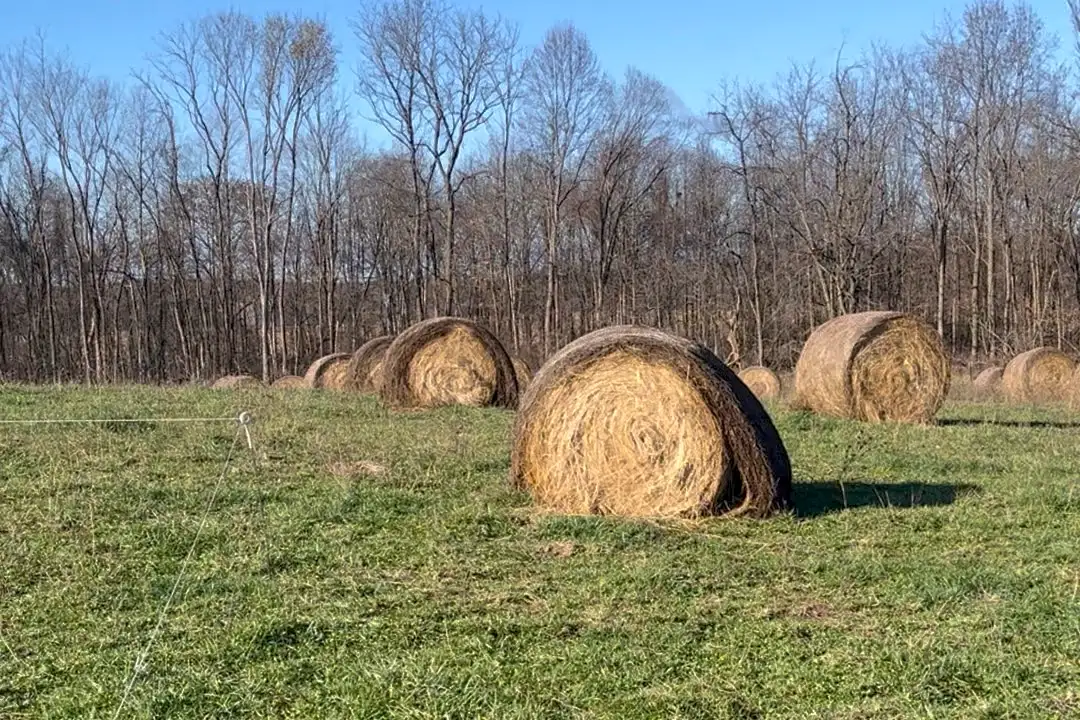
Michelle recorded these on the morning of Sunday, November 15.
The bales are out
We have about 100 round bales set out in the field for the winter. The cows get one or two at a time, and a few of our younger stock eat alongside them. They eat each bale down to nothing. It’s a good way for us to reseed our pastures.
What “unrope” means
The bales sit behind temporary rope fence, the same kind Tom moves every day when the herd is on grass. When Michelle says we unrope one or two at a time, she means opening the fence to just those bales. With about 50 head on hay, the herd usually goes through about two round bales a day. When those are cleaned up, we move the fence and open the next ones. It’s rotational grazing with stored hay instead of standing grass.
Where the hay comes from
The farm has five grazing fields. Each summer we hold some of them out of the grazing rotation for part of the season and bale them instead, so there’s hay ready for winter. We also bale fields that aren’t on the farm.
We don’t buy grain, and we only buy hay when we have to, in a year when we couldn’t bale enough over the summer. In a very dry year, a hay field might give us two cuttings instead of four.
We don’t use herbicides or pesticides on our hay fields. Through the winter, this hay is what our cattle eat. Their diet is pasture while it’s growing and stored grass the rest of the year, with no grain.
Why it’s good for the field
The cows eat most of each bale, but not all of it. They pull some of the hay out and spread it across the ground around them, and the seed and leaves in that hay go onto the field. That’s the reseeding Michelle is talking about. The cattle also leave manure where they eat, so those nutrients go back into this pasture instead of piling up around a barn. The spots where bales sat often grow back thicker the next season.
Where this fits in the year
Two weeks ago, Michelle filmed Tom moving the herd onto a pasture we held back all year, and ten days later the calves were moving through it. When the grass is done for the year, the herd moves onto these bales.
For the full explanation of how bale grazing works and what it takes, read Bale Grazing: A Sustainable Alternative to Traditional Livestock Management.
Along for every move
Bo, our red lab, loves the farm. He was born in 2019, and we’ve had him since he was a puppy. He follows Tom around all day, running alongside whether Tom is walking or driving the tractor or the ATV.
He doesn’t have a job on a move. He just loves running out with Tom to move the cows, every morning and every night, and he doesn’t miss one.
Transcripts of the videos
The bales
Good morning from Sugar Creek Farms. I’m showing you our bale system. We’ve got about 100 bales out in the field, and throughout the winter we will unrope one or two at a time for the cows to eat, along with a few of our younger stock, and they’ll just eat the bale down to nothing. It’s a great way to reseed the pastures for us.
Bo
Here’s our Bo, lab, red lab. He loves the farm. We got him as a baby, and he’s been out with Tom moving the cows every morning and every night. He wouldn’t miss it.